
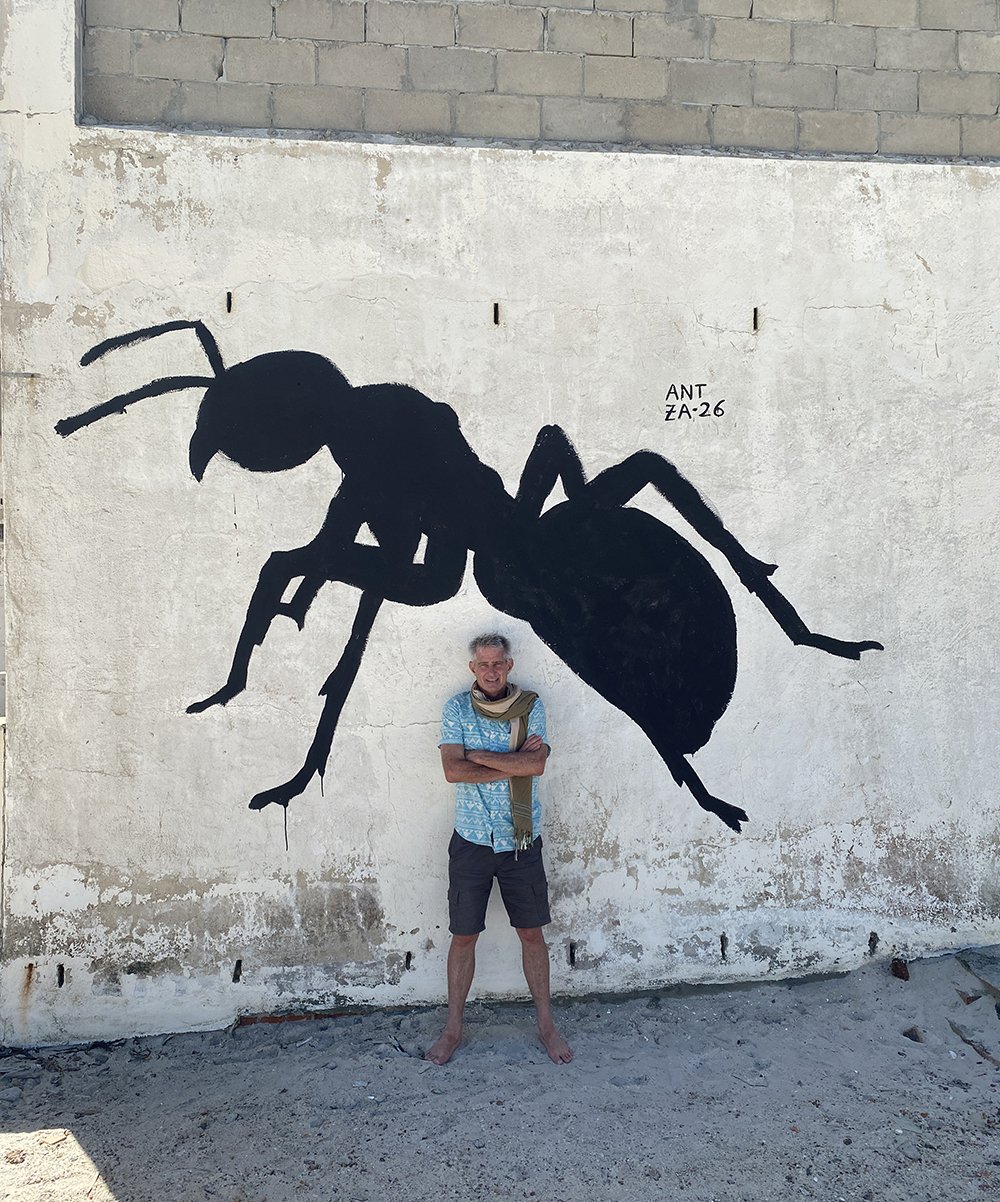
Ralph Lazar is a South African artist based in London.
His work has been showcased at Art Miami, The LA Art Show, Art Palm Springs and Art Market San Francisco amongst others.
In January and February 2020, his artwork appeared on 1,700 digital screens across New York City.
***********************************
Why do I paint ants?
I like ants.
I love the fact that there are hidden colonies beneath our feet - 20 quadrillion tiny missions that make the earth breathe. One can pass over an ant city the size of Manhattan without realising it.
To me, ants are nature's data: millions of individual lives and choices forming a single, purposeful, and unstoppable flow.
***
There are an estimated 20,000,000,000,000,000 ants on earth, a staggering number that translates to about 2.5 million ants for every human. A comforting thought, in its own strange way.
As kids in Johannesburg in the ‘70s, my siblings and I would spray down the back patio with a hose. For a few brief minutes it would look clean and bare. Then the ants would emerge - Brown Pavement Ants (Tetramorium caespitum). Within fifteen minutes the ground would be alive, moving in a thousand tiny directions. It felt like watching the earth breathe.
At university in Cape Town, ants became useful accomplices to my exam-time procrastination. I’d twist a paper clip into a ring and trick Small Black Sugar Ants (Lepisiota capensis) onto it. I’d hold the clip steadily, swapping hands whenever the ant wandered too close to my fingers. Some walked in a single direction. Others stopped, hesitated, and then went the other way. Others didn’t behave in any logical way, at least to me. But they all stayed on the clip no matter what. I followed their choices as if they revealed something important about their personalities. One day, an ant did a few loops in one direction, a few loops in the opposite direction, then jumped off. It totally freaked me out.
In my early twenties, I hitchhiked from Cape Town to Malawi. Somewhere in Zimbabwe I stood on the roadside in the thick afternoon heat, waiting for a passing lift. Then I heard something - a sharp, insistent rustling from the elephant grass, loud enough to make me look up. A thin, dark line pushed out onto the road: a raiding column of Matabele Ants (Megaponera analis). I watched them move with purpose, crossing the tarmac and vanishing into the brush.
Years later, in my late twenties, while travelling through Guatemala with my sister, we halted on a muddy road and watched a living river of Army Ants (Eciton burchellii) as they crossed, fashioning bridges from sticks and from their own bodies.
As I write this, I’m sitting on the tenth floor of a building overlooking Muizenberg Beach in Cape Town. An ant has just wandered across the windowsill in front of me. It’s most likely a lone scout from a nearby colony. It’s probably a Pharaoh Ant (Monomorium pharaonis). These guys rarely climb the exterior. Instead they colonise the interior structure of large buildings, using plumbing, air vents, heating ducts, and electrical conduits to move between floors.
I can’t help wondering whether it can sense the vast sweep of the Indian Ocean the way I can - but of course it can’t. An ant’s vision only reaches a few inches, maybe a foot at best. Still, it moves with absolute purpose, intent on some tiny mission of its own. What that mission might be, I have no idea - but a mission it certainly is.